14 min read
Good Luck Trying to Stop the Genie Once It Starts Making Money
AI is no longer just answering your questions. It is running businesses, managing social media accounts, trading on financial markets, and generating real revenue.
14 min read
Good Luck Trying to Stop the Genie Once It Starts Making Money

TL;DR
AI is no longer just answering your questions. It is running businesses, managing social media accounts, trading on financial markets, and generating real revenue for people who figured out how to point it in the right direction. We built Genie to be the AI agent that does exactly that, and then we got curious about how far it could actually go. So we tested it on content creation, business automation, and prediction markets. The results were interesting enough that we had to write this article about it.
The Quiet Takeover You Are Already Living Through
Something shifted in the last year, and most people did not fully notice it happening.
AI went from being the thing that helps you fix a grammar mistake to the thing that runs entire chunks of businesses without a human being involved at all. Customer support agents that handle thousands of conversations a day without a single person on the other end. Content systems that write, schedule, and post across five platforms while the creator is out getting groceries. Research workflows that used to take an intern three days now take an AI agent about twenty minutes.
And the part that gets really interesting is the money part. Because AI is not just automating tasks anymore. It is automating revenue. People are using AI agents to manage their social media and grow audiences that turn into paying customers. People are using AI to analyze markets and execute trades faster than any human could. People are building entire product lines where the AI handles everything from market research to pricing strategy to customer acquisition.

The work that used to require a team of five, a budget of fifty thousand dollars, and about six months of runway is now being done by one person and an AI agent in a fraction of the time. That is not a prediction about the future. That is what is happening right now, today, across every industry you can think of.

So What Exactly Is Genie?
If you have not heard of Genie yet, here is the short version.
Genie is the AI agent platform we built at Deva. When you sign up, you get your own personal AI that runs on a dedicated server. It is not a chatbot sitting in a browser tab waiting for you to type something. It is an actual AI agent that runs continuously, remembers everything you have told it, connects to the tools you already use like Telegram and Discord, and keeps working on tasks even when you are not online.
Think of it as hiring a digital employee who never sleeps, never forgets, never asks for a raise, and gets smarter about your specific needs every single day. You set it up in under a minute, no technical skills required, and from that point forward it works for you around the clock.
The Three Ways People Are Actually Making Money With AI Right Now
When we started exploring what Genie could do beyond the usual productivity stuff, we noticed three clear patterns emerging in how people are using AI agents to generate actual income. Not theoretical income. Not "projected revenue." Real money hitting real accounts.
The Social Media Play
This one caught our attention first because it is the most accessible. People are using AI agents to completely manage their social media presence. The agent researches trending topics, writes posts in the creator's voice, schedules everything across platforms, engages with comments, and optimizes content based on what performs best.

The creator's entire job becomes reviewing what the agent prepared and hitting approve. Some are not even doing that much. They set the tone, give the agent context about their brand, and let it run. The audience grows, engagement goes up, and monetization follows through sponsorships, affiliate deals, paid communities, and ad revenue.
What used to require a social media manager, a content writer, and a scheduling tool is now one AI agent doing all three jobs simultaneously and honestly doing them faster than most humans could.
The Trading Game
This is where things get spicier and also more honest, because we are not going to pretend this space is all profit screenshots and no risk.
People are using AI agents to trade across crypto markets, and for a while, the edge was real. AI could analyze patterns, execute faster than humans, and exploit tiny inefficiencies that manual traders would never catch.

But here is the reality check. The market got crowded fast. When everyone is running an AI trading bot, the bots are essentially competing against each other. The inefficiencies get smaller, the margins get thinner, and the accuracy drops because the market itself adapts to the presence of all these automated systems.
AI trading still works, but it is no longer the easy money that early adopters experienced. The edge now belongs to the agents that are smarter about which markets to enter, which data to prioritize, and when to sit out entirely. Which brings us to the part that actually made us sit up and pay attention.
Then Polymarket Entered the Chat
For those who are not familiar, here is a quick introduction. Polymarket is a prediction market platform where people bet on the outcomes of real-world events. Will a certain policy pass? Will a specific company hit a revenue target? Will BTC go up or down in the next five minutes? You take a position, and if your prediction is correct, you get paid.
Think of it as the stock market, except instead of buying shares in a company, you are buying shares in an outcome. The price of each outcome reflects what the crowd thinks the probability is. If the crowd is wrong and you are right, you make money.
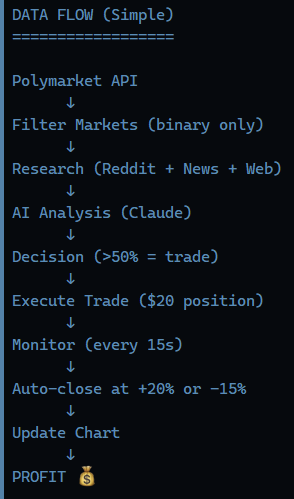
Polymarket has been around for a while, but what changed recently is that they released a CLI, a command-line interface that lets AI agents integrate directly with the platform. That means an AI can read market data, analyze probabilities, and place positions programmatically without a human clicking buttons on a website.
When that happened, something clicked for us.
We Got Curious, So We Let Genie Loose on It
The combination of a prediction market that rewards correct analysis and an AI agent that can process massive amounts of information felt like it was designed for each other. So we spun up a few sub-agents inside Genie and ran an experiment to see if the system could actually find profitable opportunities on Polymarket.
The first thing Genie did was filter the markets. Polymarket has hundreds of active questions at any given time, and not all of them are equally useful for an AI-driven strategy. Some questions have multiple possible outcomes, like "Which candidate will win the primary" with six options. Those are harder to analyze cleanly because the probability is spread thin across too many variables.
So Genie focused specifically on binary questions. Yes or no. Two outcomes only. Will this happen or will it not. By narrowing to binary markets, the agent reduced complexity and risk at the same time, because every question becomes a single probability curve instead of a messy distribution across half a dozen options.
How It Actually Analyzes
Once Genie identified the right markets, the analysis layer kicked in. This is where it gets genuinely interesting because the agent does not just look at the Polymarket odds and guess.
Genie pulls information from multiple sources simultaneously. Reddit discussions, Twitter conversations, news articles, blog posts, and any relevant public data it can find about the topic of the prediction. It cross-references all of that against the current market probability to figure out whether the crowd is pricing the outcome correctly or whether there is a gap between what the data suggests and what the market believes.
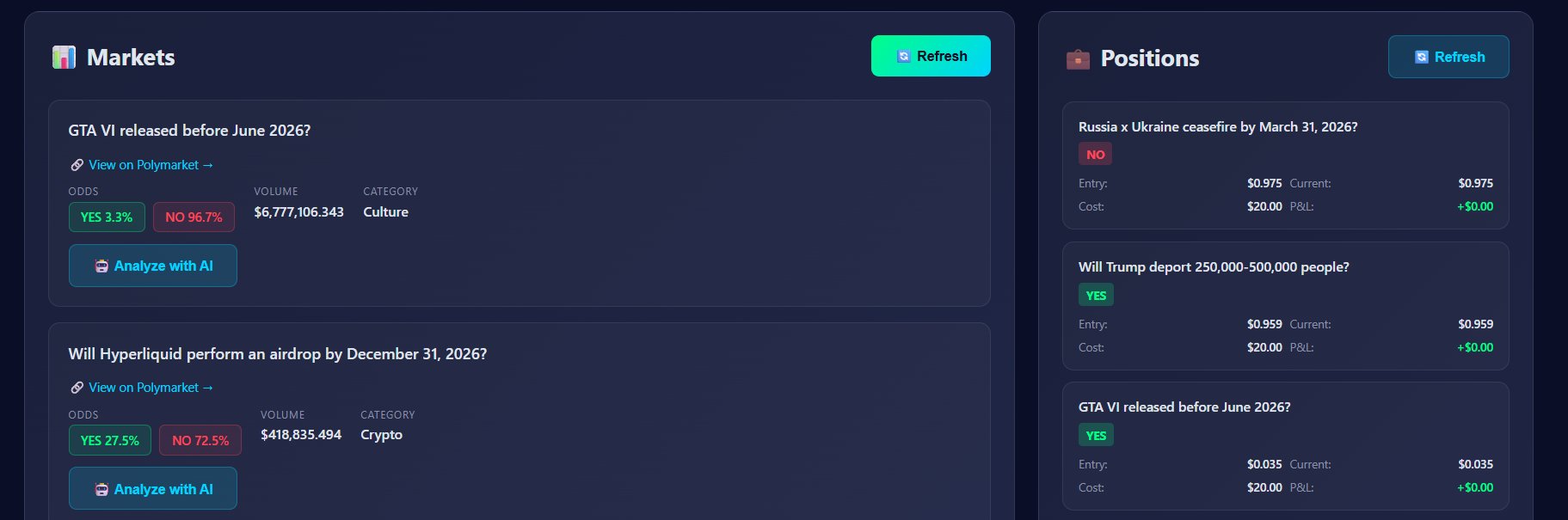
Think of it like this. If a Polymarket question asks "Will Company X announce a product launch this month" and the market says 35% yes, Genie goes and reads every recent article, tweet, Reddit thread, and press release about that company. If the data overwhelmingly suggests that the launch is happening, but the market has not caught up yet, Genie identifies that gap as an opportunity.
The agent looks at the probability curve and finds the steep. If the probability of yes is sitting below 50% but the data strongly supports a yes outcome, the agent leans into that direction. If the data supports no, same logic applies in reverse. It is not guessing randomly. It is making informed calls based on a volume of information that no single human could process in the same timeframe.
The beautiful part is the simplicity of the underlying logic. Binary question, two outcomes, probability curve, data analysis, smart position. The agent books profit not by predicting the future with magic, but by reading the present more thoroughly than the average market participant.
This Was Just the Test Run
We want to be clear about something. The Polymarket experiment was exactly that, an experiment. We ran it to see whether Genie could handle real-time data analysis, make informed decisions across multiple markets, and actually produce results worth talking about.
It did. But that is not the point of this article.
The point is what this tells you about where things are heading. Polymarket was one test. Social media automation was another. Business analysis, content creation, service marketplace listings, revenue strategy, all of these are experiments we have run or watched users run on Genie. And every single one of them demonstrated the same thing.
When you give an AI agent persistent memory, continuous execution, real tool access, and a clear goal, it does not just complete tasks. It starts finding opportunities, building plans around them, and executing with a speed and consistency that would cost you an entire team to replicate manually.
The people who are going to build the next wave of successful businesses are not going to be the ones with the biggest budgets or the largest teams. They are going to be the ones who figured out how to point an AI agent at a problem and let it work.
The possibilities from here are genuinely endless. Any idea you have been sitting on because you did not have the time, the team, or the technical ability to make it happen, that barrier is gone now.
Turning any idea into a reality is the new reality. And that is exactly what Genie was built to make possible.

Share
Post on social or copy the link to share anywhere.